Lezato - Restaurant Admin Dashboard UI: A Comprehensive Evaluation for Modern Food Businesses
In the rapidly evolving landscape of digital hospitality, the efficiency of an internal management system can be just as critical as the quality of the food served. For restaurant owners, managers, and developers tasked with building custom ordering platforms, selecting the right user interface (UI) template is a pivotal decision. Lezato - Restaurant Admin Dashboard UI has emerged as a significant option in this category, offering a specialized design framework tailored specifically for the complexities of food ordering, delivery logistics, and reservation management. This evaluation explores what distinguishes Lezato from generic dashboard solutions, its practical application for various business models, and the factors to consider when deciding if it aligns with your specific operational needs.
Understanding the Core Architecture of Lezato
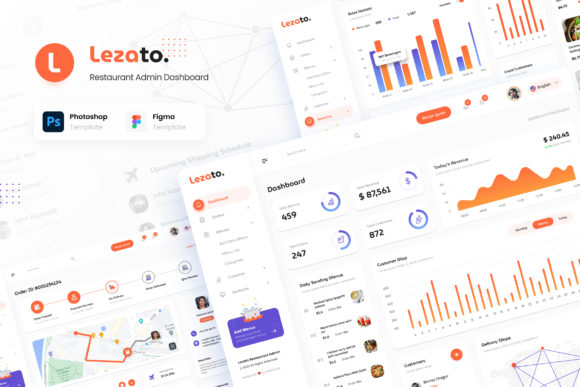
At its foundation, Lezato is not merely a collection of pretty screens; it is a structured solution designed to handle the high-volume data interactions typical of the restaurant industry. Unlike broad-spectrum admin templates that attempt to serve e-commerce, SaaS, and corporate clients simultaneously, Lezato focuses exclusively on the culinary ecosystem. The template provides a complete set of six unique and modern User Interface screens available in both PSD and Figma formats. This dual-format availability is a distinct advantage, allowing teams to choose between pixel-perfect raster editing or vector-based component design depending on their workflow preferences.
The design philosophy behind Lezato prioritizes clarity and speed. In a busy kitchen environment or during peak delivery hours, administrators need to process orders, manage customer inquiries, and review analytics without cognitive overload. The template addresses this by utilizing a clean layout that highlights essential information immediately. The inclusion of free Google Fonts ensures that the typography remains legible across all devices while maintaining a professional aesthetic that does not require additional licensing costs. Furthermore, the documentation provided with the template is well-structured, guiding users through the customization process to ensure that even those with limited design experience can adapt the interface to their brand identity.
Detailed Breakdown of Functional Components
The value of any admin dashboard lies in the depth and usability of its individual pages. Lezato offers a comprehensive suite of views that cover the entire lifecycle of a restaurant's operations. Each screen is designed with a specific function in mind, reducing the friction between different administrative tasks.
- Dashboard Panel: This serves as the command center. It aggregates key metrics such as total revenue, active orders, and daily sales trends. The visual hierarchy allows managers to spot anomalies or opportunities at a glance, making it ideal for quick decision-making during service hours.
- Order Page List: Managing a stream of incoming requests requires a robust list view. This screen organizes orders by status, time, and priority. It is designed to help staff filter through cancellations, pending preparations, and completed deliveries efficiently.
- Order Detail: When an issue arises or a modification is needed, the detail view provides deep insight into a single transaction. It displays customer specifics, itemized menus, special instructions, and payment status in a consolidated format.
- Customers Page: Retention is vital for restaurants. This section allows administrators to view customer history, track loyalty points, and manage contact information, facilitating better relationship management.
- Analytics Page: Data-driven growth is possible only with accurate reporting. This page transforms raw numbers into actionable insights, helping owners understand peak times, popular menu items, and seasonal fluctuations.
- Review Page: Reputation management is crucial in the age of online dining reviews. This screen centralizes feedback from various channels, enabling businesses to respond promptly and maintain a positive public image.
Comparative Analysis: Specialization vs. Generalization
When evaluating Lezato - Restaurant Admin Dashboard UI, it is helpful to compare it against two primary categories of alternatives: generic multi-purpose admin themes and fully custom-built software solutions. Generic templates are often attractive due to their low cost and vast feature sets. However, they frequently suffer from "feature bloat," including unnecessary modules for inventory, HR, or manufacturing that add clutter to the user interface. For a restaurant owner, navigating a complex dashboard filled with irrelevant tools can slow down operations.
Conversely, building a custom solution from scratch offers total control but demands significant investment in time, budget, and technical expertise. Custom development cycles can take months, delaying the launch of a new food ordering platform. Lezato occupies a strategic middle ground. It provides a specialized structure that eliminates the noise of generic templates without the prohibitive cost and timeline of bespoke coding. While a custom build might offer niche features for highly specific supply chain needs, Lezato covers 90% of standard restaurant requirements out of the box.
Another point of comparison is the file format flexibility. Many competitors lock their designs into a single format, forcing users to learn a specific tool. By providing both PSD and Figma files, Lezato accommodates different design cultures within agencies and in-house teams. Designers who prefer the precision of Photoshop can work with layers and smart objects, while UX/UI specialists who favor the collaborative nature of Figma can utilize components and auto-layout features. This versatility is a rare strength in the current market.
Strengths, Tradeoffs, and Best-Fit Scenarios
The primary strength of Lezato lies in its readiness and aesthetic appeal. The 1920px width pages ensure that the interface looks stunning on modern desktop monitors, which are still the primary workstation for many restaurant managers. The eye-catching design helps reduce fatigue during long shifts. Additionally, the use of standard web fonts and well-documented code structures makes the transition from design to development smoother than with poorly documented templates.
However, potential users must consider certain tradeoffs. As a static UI kit, Lezato is not a functional software application. It does not include backend logic, database connections, or real-time order processing capabilities. Users must have access to a developer to implement the frontend design into a working system using technologies like React, Vue, or PHP. If a business owner is looking for a turnkey solution where they can simply upload the files and start taking orders immediately, this template will not suffice without further engineering.
Furthermore, while the images included in the preview are high-quality, they are for demonstration purposes only. The final product will rely on the user to source appropriate placeholder imagery or integrate their own photography. This is a standard practice in the industry but requires attention to detail to ensure the final look matches the professional tone of the template.
This template is best suited for:
- Restaurant Chains: Organizations managing multiple locations need consistent, scalable interfaces that can be easily deployed across different branches.
- Food Delivery Startups: New ventures launching on-demand delivery apps benefit from a pre-designed, mobile-responsive admin panel that accelerates their go-to-market strategy.
- Development Agencies: Freelancers and agencies serving the hospitality sector can leverage Lezato to deliver high-quality client projects faster, improving their profit margins.
Decision Factors and Final Considerations
Choosing the right admin dashboard involves balancing immediate needs with long-term scalability. If your project requires a highly unique, branded experience that deviates significantly from standard layouts, you may find the fixed structure of Lezato limiting. In such cases, starting with a blank canvas or a more modular framework might be preferable. However, if the goal is to establish a reliable, modern, and efficient system quickly, Lezato offers a compelling value proposition.
The emphasis on documentation is another critical factor. A template that is easy to edit and customize reduces the risk of errors during implementation. With 6 dedicated pages covering the most critical aspects of restaurant management, the learning curve is minimized. The ability to switch between Figma and PSD also future-proofs the project, allowing the team to adapt to changing software standards over time.
Ultimately, the success of a restaurant admin system depends on how well it supports the human element of the business. Lezato - Restaurant Admin Dashboard UI succeeds by removing visual clutter and focusing on data that matters. Whether you are tracking the latest analytics, managing a flood of customer reviews, or ensuring every order leaves the kitchen correctly, this template provides the structural foundation necessary for a streamlined operation. For those ready to move beyond basic spreadsheets and generic tools, it represents a solid investment in digital infrastructure.